- Founders Only
- Posts
- Sometimes the wrong answer is right
Sometimes the wrong answer is right
Failure can be fortunate and it's almost never forever

John Hancock
July 22, 2025
Howdy Founders 🤠
This is one of two newsletters you’re getting this week (See you again on Friday with something special). In this one we’ll cover:
3 Types of Idea People and How to Move to the Right Place on the Spectrum
How to Use Wrong Answers as Your Secret Weapon
A business idea I personally validated in 2020
The Three Types of “Idea People” (And How Not to Be the First Two)
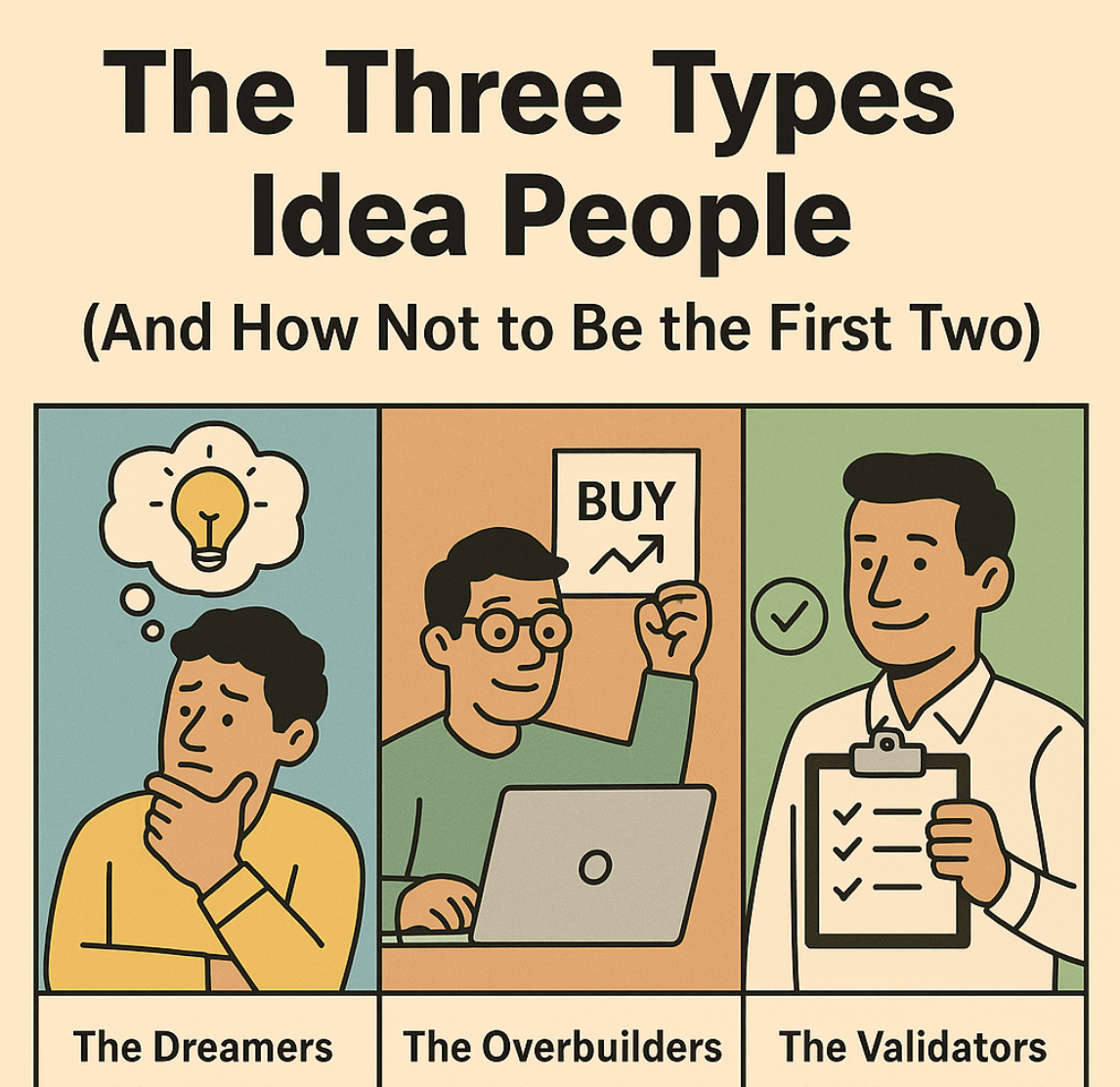
Let’s talk about idea validation. Not the “I just had a shower epiphany and now I’m a billionaire” kind, but the real, slightly-messy, sometimes-awkward process of figuring out if your idea is actually worth anything before you torch your weekends or your savings.
I keep seeing the same three types of founders show up at the starting line:
1. The Dreamers (aka “Wouldn’t It Be Cool If…”)
These folks have ideas for days. They’re the ones texting you at midnight with “What if Uber, but for lawn chairs?” But when it comes to actually building something, they freeze. Maybe it’s imposter syndrome. Maybe they’re busy. Maybe they just don’t know where to start. Honestly, I get it. Starting is scary. The world’s full of reasons not to do something, and your calendar is probably one of them.
2. The Overbuilders (aka “Let’s Buy the Domain!”)
This group? Oh, they move fast. Too fast. They’ve bought six domains, filed for an LLC, maybe even outsourced a logo on Fiverr before talking to a single customer. They’re high on Hormozi, hyped by Pristley, and convinced their idea is so good it’ll sell itself. Spoiler: it won’t. The pain point might not be real, or it’s just not painful enough, or maybe it’s already solved by three better-funded startups with teams twice your size. These folks are running a marathon in the wrong direction, but hey, at least they’ve got cool business cards.
3. The Validators (aka “The YC Grads”)
Then there’s the third group. These are the ones who know the game. They spin up a landing page in an afternoon. They talk to customers on day one, not day 100. They know what “success” looks like before they even start. They’re allergic to busywork, and they don’t spend money until they know someone actually cares. Think Paul Graham’s “Do things that don’t scale”.
These folks aren’t smarter, just more disciplined (or maybe more allergic to wasting time).
How to Move from Dreamer or Overbuilder to Validator
Here’s the thing: most of us start out as either Dreamers or Overbuilders. The trick is to slide toward the middle of the spectrum. Here’s what’s helped me (and what I wish someone had told me earlier):
Talk to real people, fast. Not your mom. Not your co-founder. Actual potential customers. Ask dumb questions. Listen more than you pitch.
Don’t build. Test. A landing page is enough. A Google Form is enough. Hell, a tweet is enough. The goal is to see if anyone cares, not to win design awards.
Define your “kill criteria.” Before you start, decide what success looks like. Is it 100 email signups? Three people who’ll pay you right now? If you don’t hit it, move on. Dalton Caldwell calls this “ruthless prioritization”—and he’s right.
Ignore the busywork. Don’t buy the domain. Don’t file the LLC. Don’t order business cards. None of that matters until you have proof there’s a problem worth solving.
Be curious, not precious. Your idea isn’t your baby. It’s a science experiment. If it fails, cool, you learned something. If it works, even better.
What the YC Crowd Gets Right
The YC approach isn’t magic. It’s just a relentless focus on reality over fantasy. Sam Altman says, “Startups are about finding the intersection of what you’re good at, what you enjoy, and what people want.” Notice how “what people want” is a full third of the equation.
So if you’re stuck dreaming or overbuilding, try doing less. Talk more. Validate early. And remember: nobody cares about your idea until you prove it solves a real problem for real people.
And if you still want to buy the domain? Fine. Just wait until you’ve got your first customer.
BTW:
I’m currently validating an idea about validating ideas and would love for some feedback if you have a few minutes. Just reply and let me know you want to try my Idea Validation Idea and I’ll send you a link and anxiously await your feedback. Thanks!
⁉️ Use the WRONG answer to get things right
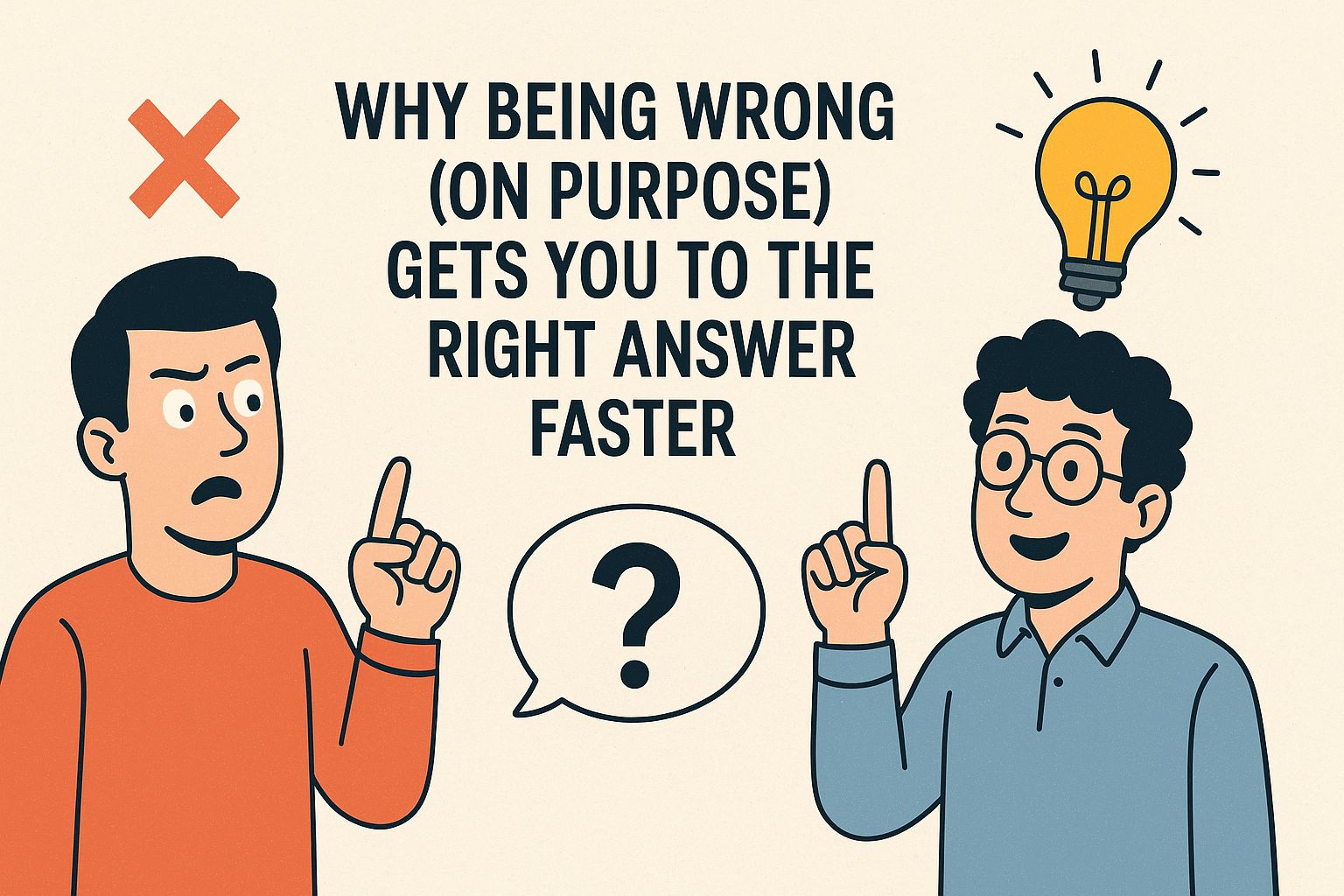
Why Being Wrong (On Purpose) Gets You to the Right Answer Faster
Here’s something I stumbled into after one too many awkward silences in team meetings: sometimes, the fastest way to the right answer is to confidently blurt out the wrong one. I know, it sounds like startup heresy. But hang with me.
The Method Behind the Madness
There’s actually some brainy stuff behind this move. The Socratic method—yeah, that ancient Greek thing—was built on asking dumb questions and letting people talk their way to truth. Turns out, stating something wrong out loud works a lot like that. It forces everyone to stop, think, and (usually) correct you.
Then there’s “errorful generation,” which is a fancy way psychologists say we learn better by making mistakes. When you give a wrong answer, your brain (and your team’s) jumps into gear to fix it. Suddenly, people who were zoning out are fired up to set the record straight.
How I Use This Trick
Unsticking Brainstorm Sessions: If nobody’s talking, I’ll throw out a ridiculous solution. It’s like lighting a fire under the team. Even if they just laugh, it gets the ideas flowing.
Tough Decisions: When we’re spinning our wheels, I’ll sometimes argue the obviously-wrong path. It’s amazing how fast everyone rallies around what we should do instead.
Hiring Debates: I’ll play devil’s advocate for the candidate nobody wants. Sometimes, it clarifies what we’re really looking for.
A Bit of Caution
Don’t overdo it. If you’re always the “wrong answer” person, people stop taking you seriously. But used sparingly, it’s a weirdly effective way to get your team thinking—and talking.
So next time you’re stuck, try being confidently, spectacularly wrong. Worst case, you get corrected. Best case, you unlock the answer that was hiding in plain sight.
💡 Business Idea of the Week
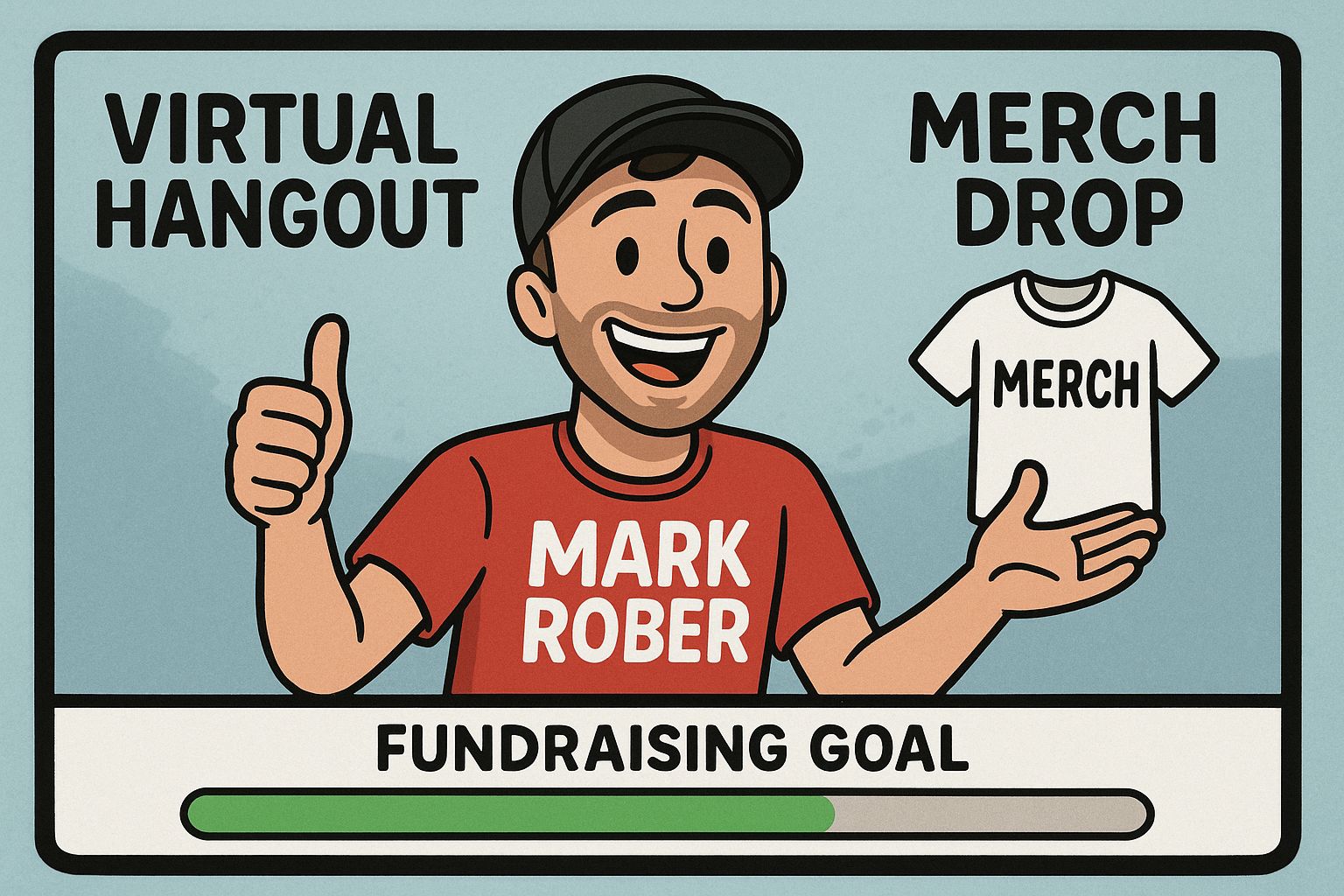
Crowdfunding platform for content creators 📺️ 💰️
This one is a little different from the usual Biz Idea of the Week because I actually built this one back in 2019-2020 and had real traction before pivoting to try and solve problems related to Covid. I never talked about it because I always assumed I would pick it back up again but these days I have too much going on and I’m ready to let it fly the coop.
Charity isn’t exciting
We started as a way to help content creators use their powers for good by offering a really simple way to connect their content to a charity of their choice. Unfortunately, people are hesitant to give to a charity just because an influencer or YouTuber says its a good one.
Content is King 👑
Through some experimentation, we found that people WOULD be willing to give money to support their favorite content creators in their content creation endeavors. But this wasn’t a unique idea. There was already Patreon and Onlyfans.
A niche of “Specificity”
Luckily we found a behavior that was not being explored by Patreon or Onlyfans (and still isn’t today) that was valuable to content creators. Specific content goals.
Things that might surprise you:
Content creators are typically afraid to ask for general support beyond a “Like and Subscribe”
Most of them don’t even like the idea of selling merch because they fear it will be seen as a money grab.
Like 99% of content creators make all of their money from sponsors and ad revenue. They don’t earn much but at least they don’t look needy/greedy.
Things that won’t surprise you:
99% of content creators can’t afford to make significantly higher budget content. Essentially no YouTubers can’t make a video on par with Mark Rober, because they don’t have the money (see above).
Audiences WANT to see their favorite creators make better, higher budget content.
Put it all together
Enter a new kind of creator support. Content specific crowdfunding.
How it works:
The YouTuber draws up a plan of what kind of content he wants to make (ie: “I want to put a monkey into orbit using only rocket parts I find a junkyards”)
A funding goal is established (ie: $200k)
A series of reward tiers are created for “Funders”
$50 = a shirt and exclusive early access to the new video
$100 = a shirt and access to an exclusive virtual hang out and launch party
$500 = an in-person hangout at Dave & Busters
Creators get to ask for support without feeling cheesy because there is a specific reason for the ask, which is intent on bringing direct value to the audience.
If you’re interested in pursuing this, I’m happy to talk you through any gaps and discuss early validation plans. Just let me know 🙂
THE END
This newsletter is about life as a founder and the lessons and emotions I feel are unique to this particular lifestyle. If there’s anything in particular you won’t me to write about, hit me up!
Thank you for reading 🙏 ❤️
Later this week, I have an exclusive interview with the founder of one of the fastest growing unicorns ever so keep an eye out for that on Friday!
I love you,
— John